

Peter McCulloch and Tom Longabaugh discuss Temperance, their unique modal reverb, and life on Eventide’s plugin team.
Peter, what does your background look like?
Peter: My background is in music composition, with a focus on interactive music and Max. I got my doctorate about 10 years ago and I taught for 10 years at NYU and Vassar College. And then eight years ago I joined Eventide.
I’ve done a little bit of various things. I’ve done some algorithm design. I worked on Tricerachorus and Harmadillo for the H9. But mostly I’ve done plugin work.
Oh wait, the company name is pronounced “Even-tide”? I’ve been pronouncing it wrong this whole time!
Peter: Yeah!
Ahh!!
Peter: It happens all the time, to the point where we’ve joked about making a plugin called the Steven-tide.
I feel pretty embarrassed…
Tom: I would say a sizable majority of the people I encounter in the wild say “Evan-tide”
Wait, people say Evan-tide!? I’ve been saying Event-ide!
Peter: A third contender has emerged! [laughs]
Tom: I thought you were mispronouncing it differently than you actually were!
[laughs] Yes, we need a plugin called “Even Steven” or something to rub it in. So, Tom, you’re the Boss o’ Plugins, the manager?
Tom: Yes, I lead and manage the team.
What’s your history at Eventide?
Tom: I started in 2014, when I had a summer internship here. I basically spent the summer working on updating the UIs of a few plugins. After starting full-time, I helped ship the Anthology X bundle, worked on the first version of Physion [née Fission] and some of the H9 plugins. On every plugin we’ve done since, I’ve written some code and/or did product design. Now I split my time between writing code and doing whatever managerial stuff needs to happen.
Peter: You do a lot of our framework stuff and have a ton of the institutional knowledge.
Tom: I am usually the guy doing a lot of the maintenance work because I know where everything is.
So you *are* Eventide plugins in terms of knowing where everything lives.
Tom: Yes, to an extent. Eventide made TDM plugins in the 2000s and we still get support questions every now and then.
Peter: My understanding is we contributed some of the AAX wrapper in JUCE?
Oh, that’s the lore?
Tom: The lore I’ve heard is that we wanted to ship AAX plugins before JUCE supported them, so we wrote an AAX wrapper for ourselves, sent it to Jules and Jules rewrote the whole thing! The Eventide employee who wrote the wrapper was not happy about that…
[laughs] Sounds plausible!
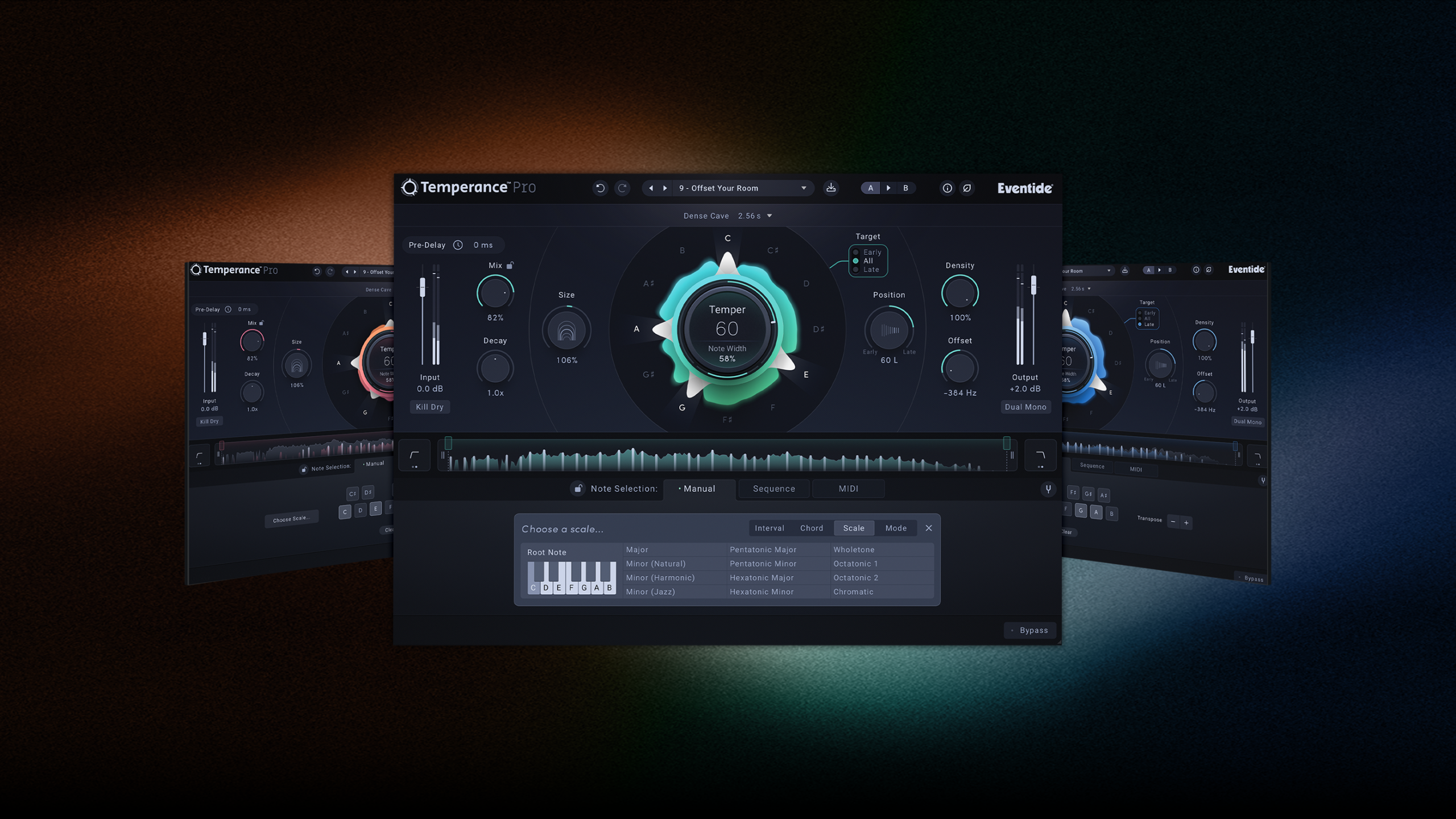
How do you guys come up with something like Temperance? Where does the initial grain of the idea start? Who gets to decide if it’s made?
Tom: Eventide has a dedicated DSP team who are responsible for the deep signal processing R&D. Usually what happens is they’ll land on some cool idea, and then through a pretty organic process, we’ll all kind of agree that it’s something we all want to work on.
For Temperance specifically, Tony Agnello, who’s the president of Eventide [Ed: Until January 2026, when he passed the baton] — he was the first engineering hire, the engineer behind the harmonizers and the SP2016 Reverb — he had this idea in his head for the past 40 years and the technology with modal reverbs has caught up to the point where we can do it in real-time.
By the time the plugins team gets involved, the core characteristics of the sound have been landed on. We jump in and start working on productizing it.

So you are doing more than just dev. It’s product development. You are taking a kernel of DSP and figuring out how to present it.
Peter: Yeah, how will users interact with it? What are good controls? Are there affordances that we need to provide to make these interactions more obvious?
You have a free version and the pro version. How did you decide to make a free version?
Tom: That came later in the process. We started with Pro. Tony wanted to get the technology out in front of as many people as possible and made the call that we should do a free version.
Peter: What ended up being in Lite is pretty similar to something we had at one point — we’ve made so many versions of the thing! [laughs] When you make something that’s new, you have to figure out how not to confuse users.
Peter: We had a similar kind of task with SplitEQ, trying to figure out what’s a good interaction model for this stuff that people will not be overwhelmed by. A lot of it is thinking about information management in a certain sense.
Yeah, sometimes it’s not only a UX challenge but a mental model challenge. When I first saw Temperance, it took me a second to understand it was something more than just an algorithmic reverb. It sounds really cool!
Peter: Yeah, it is this kind of really interesting middle ground between algorithmic reverb and convolution reverb. It gives you the kind of customizability that you get from an algorithmic reverb, but you can say, “I want this space, I want this IR.” There was a lot of R&D and some patents that went into getting that to happen.
So the light version has three of those… spaces?
Peter: Yes, we call them modal responses.
And they can be dialed in with normal controls, like decay time and size — but there’s also this “notes” concept, which is a big feature in this product. Is it filtering, or is it doing something crazy?
Peter: It’s thousands of parallel resonant filters. Each filter has a center frequency, a gain, a decay parameter and a phase.
Tom: With the notes, we take all of the filters that are within a certain bandwidth of a frequency that corresponds to the note that is selected. Then we emphasize or de-emphasize them.
Peter: And the modes are ordered — in order of importance. So the density knob on the pro version removes less important modes as you turn it down.
I love the visualization and the fact that it’s real time. Did you guys have to work hard on that? Did you make twenty-five implementations of that? [laughs]
Peter: We went through a lot!
Tom: That was all Peter really, just doing tons of trial and error and prototypes.
Peter: Originally it was FFT-based. But you don’t get sufficient resolution down low. So you’re going to get a lot of notes bleeding into “not nodes.” So what we’re actually doing is sampling an aggregation of the filter states directly. It gives you better separation and there’s something about it that I like.
It’s super satisfying! Putting a spectrum-ish thing on knobs can get weird, but this is top-tier. It feels really nice.
Peter: It’s all juce::Path painting.
Really! But how do you get that glow effect?
Peter: Those are just paths! Take the same path and offset it a little or scale up a little.
Wow, nice work! I pride myself on my JUCE path abilities but I wouldn’t have thought of doing that.
Tom: Several years ago we would have been like, “Let’s do it in OpenGL.” With OpenGL being deprecated on Mac and a pain to support on Windows, Peter’s been looking at tricks for using the native path stuff to make complex visualizations. The Direct2D support on Windows has helped with the performance of that. Before it probably wouldn’t have been feasible without blowing up the CPU.
Overall has Direct2D been a happy place for you?
Peter: We’re glad not to be writing OpenGL.
Tom: The overall performance improvement has been great. Temperance started on JUCE 7 but we got it on JUCE 8 pretty early and it was pretty much smooth sailing from there.
Tom: Now that we’ve been going back and starting to update our other plugins, we need to go and tweak things to get it to match. We encountered a few differences in the UI between JUCE 7 and 8. We’ve got what, like thirty-five plugins or something? We have just a little bit of legacy code…
Yeah, let’s talk about that for a second. I went on your website and stopped counting around 30. What’s it like to maintain that many products?
Tom: It’s definitely a sizable chunk of work and time. That said, our plugins share a lot of common code and use the same copy of JUCE, which helps a lot with the maintenance. If there’s a bug that affects a number of plugins, or an update we need to make across the full plugin line, we can do it relatively quickly.

The surface area is very large even when making one single change, I guess.
Peter: It’s the trade-off between that and fragmentation, basically.
Are there developers who work only on maintenance or does everyone work on everything?
Peter: Well, you’re talking with two thirds of our plugins team right now! It’s a bunch of squirrels in a trench coat! [laughs]
[laughs]
Tom: We’re quite a small team. We have 3 full-time devs on the plugin team and 1 product owner/specialist. Plus QA engineers and DSP engineers who split time with hardware as well. So you know, it’s not just the three of us, but as far as maintaining the plugins and handling OS updates, it’s the three of us.
Wow, I thought you were a team of — I don’t know, five to ten?
Tom: It’s kind of this funny perception in the plugins marketplace. Just because Eventide has been around for so long and has such a storied history, everyone assumes we’re a mega-corp.
I think audio companies generally punch above their weight in terms of number of products or quality of products to number of developers.
I mean, three people kind of qualifies as “indie” at this point! [laugh] Even though you have a fifty–year history. Speaking of, do you feel the weight of that cherished history behind you when you are releasing something like a reverb?
Tom: I mean yeah, definitely.
Peter: You want to live up to it. We make a lot of cool stuff that people depend on for their sound.
One of the things that is a plus about this history is that there’s an established culture. And it’s one that I happen to agree with. It’s a company that generally behaves ethically towards its customers.
Tom: There’s a very strong culture of support.
Peter: Yeah, and there’s curiosity and wanting to push things.
It must be pretty fun to work at a company that specializes in both hardware and software.
Tom: One thing I think is really cool with the structure of our company is that we’re writing the same DSP code between hardware and plugins. All of our hardware products are now ARM-based, some of them run bare metal, some Linux. So if you come up with an algorithm, it can go in both hardware and in a plugin, which is kind of a unique and fun opportunity. Cross-pollination between hardware and plugins.
So what the DSP engineers work on is portable?
Peter: Yeah, on the H9000 you can actually assemble modules at runtime. You can build patches and send them over to the machine while it’s still running and here’s your new effect. And that is open for users. Are you familiar with RNBO?
Yes.
Peter: The H9000 supports RNBO as well. Our code is definitely more flexible than it ever was. It used to be our hardware was running Motorola chips until maybe 10 years ago. The H9 was the last of the Motorola products. And then there was a long march to convert everything from fixed point 56k code [Motorola 56000] into C, without losing the sound.
I really like learning about all this. Plugin companies are always weird, but it’s especially unique that you are embedded in this company with such a long history in hardware. There’s been so many phases of this company.
Tom: Eventide itself is a very weird company. There’s been all of these offshoots and divisions. For a while there was an aviation division because one of the founders, Richard Factor was a hobbyist pilot. There was a time when there was no map technology available when you were flying. So he was like, “Well, my company makes electronics, let’s do that!”
There’s a whole other side of the business making logging devices for mission-critical 911 call centers that need to log everything that goes in and out.
Wow, that still exists today?
Tom: That still exists.
Peter: Yeah, there’s an entire division of the company that’s actually bigger than the audio division!
And you are all at the company picnic together? [laughs]
Both: Yeah! [laughs]
Is there any cool old code that you stumble across in the archives, like, “What’s this thing from 30 years ago?”
Peter: Definitely! The SP 2016 Reverb was my first project when I started here. That was something Tony Agnello built like… 40 years ago? It’s digital but pre-microprocessor. He had some designs that he’d sketched and some schematics from when he built the rackmount unit in the early 2000s. There’s a lot of code archaeology from that.
Something that’s interesting about those reverb algorithms is that they don’t use any modulation. That means that the delay length values have to be really carefully chosen in order to produce a smooth tail. The original hardware unit only ever ran at a single sample rate. Plugins, of course, need to run at multiple sample rates. That produced some challenges, especially since the original unit has an unusual sample rate. (This was pre-codecs, so all of the converters were built in-house)
We had an implementation and it sounded pretty good, but I was unable to get it really dialed in with either of the rackmount units. It was close, but not quite it. Once we finally got the thing running at the right sample rate, it was like, “That’s the sound!” — running it at the right sample rate made all the difference. That was very satisfying to figure out.

That’s amazing. So you were reverse engineering based on smatterings of code and ideas? Or did you have compilable code?
Peter: I didn’t have compilable code. I had printouts of the 56k code of the Princeton Digital Reverb 2016 box. And then Tony had made a block diagram based on what he remembered when he was making that unit.
It’s such a great sounding box. It’s a great reverb that’s not an obvious reverb. It just wraps around whatever you’re putting in it and is very seamless and clean.
This is a random bit of trivia I picked up in the process: Reaper will let you run arbitrary sample rates (if you set it to not use a driver). So then we had to write a really weird resampler for a non-integer sample ratio.
As a first project that’s pretty intense!
Peter: Honestly, it was supposed to be a layup! Like, “We’ve already done this once.”
Tom: It’s never a layup, though!
Peter: It’s never a layup! [laughs]
Tom and Peter were interviewed by Sudara from melatonin.dev.
Have comments on this interview? Ideas for who we should talk to next? Let us know on the JUCE forum.